
It really is about the senses. The new exhibit (thru Aug. 2, 2025) by artist Jack Whitten taught me something more dazzling than all his different forms of artworks. The exhibit was curated by the different formats of this Black artist activist during the Civil War — acrylic, slabs of acrylic, mosaic, sculpture, and more. Each introduction of a new art form started with “at [time], Whitten came up with yet another brand new way of expression.” These seemingly crude, oversimplified introductions in fact delivered a surging feeling in the heart of the visitor, prompting them to ask, “so what’s next? What could be the next thing?”

At least that’s what I was thinking when I walked into the second to last section of the exhibit, where Whitten started to let his acrylic blend into dizzying shapes. Instead of coming up with a new form, he let the new form come to him, because he confessed to having lost control of what would happen in life. At a time where the Civil Rights Movement seemed to have fruitful results but was also still suffering from more and more backfires, control, power, and identity were merely shapeshifting shadows, and the first manifestation of the feeling is the dizzying, shivering body. The structure of the exhibit hall, the normally perfect geometric shapes, suddenly became complicit in the uncontrollable-ness of the paintings, as they heighten the repetitive, non-stop, countless acrylic lines in Whitten’s paintings.

This was where I noticed why I was enjoying my visit to the MoMA so much, even compared to the reputed Metropolitan Museum of Art. The exhibit halls in MoMA are layered — You’d often see a screen standing after another screen, in front of a which is a sculpture with an accompanying painting. In a stark contrast to the artistic-looking MET, or Boston’s Museum of Fine Arts, MoMA is surrounded by glass-windowed skyscrapers, sharing a yard with modern office buildings. Many of MoMA’s first acquired artworks were also those despised by the MET collectors. A major influence in MoMA’s architectural design, MoMA Director Alfred H. Barr Jr. advocated for minimal ornamentation rather than a traditional, Beau-Arts style. The architecture manifests its space in subtlety, allowing visitors to be mazed and soothed by the simplistic design at the same time.

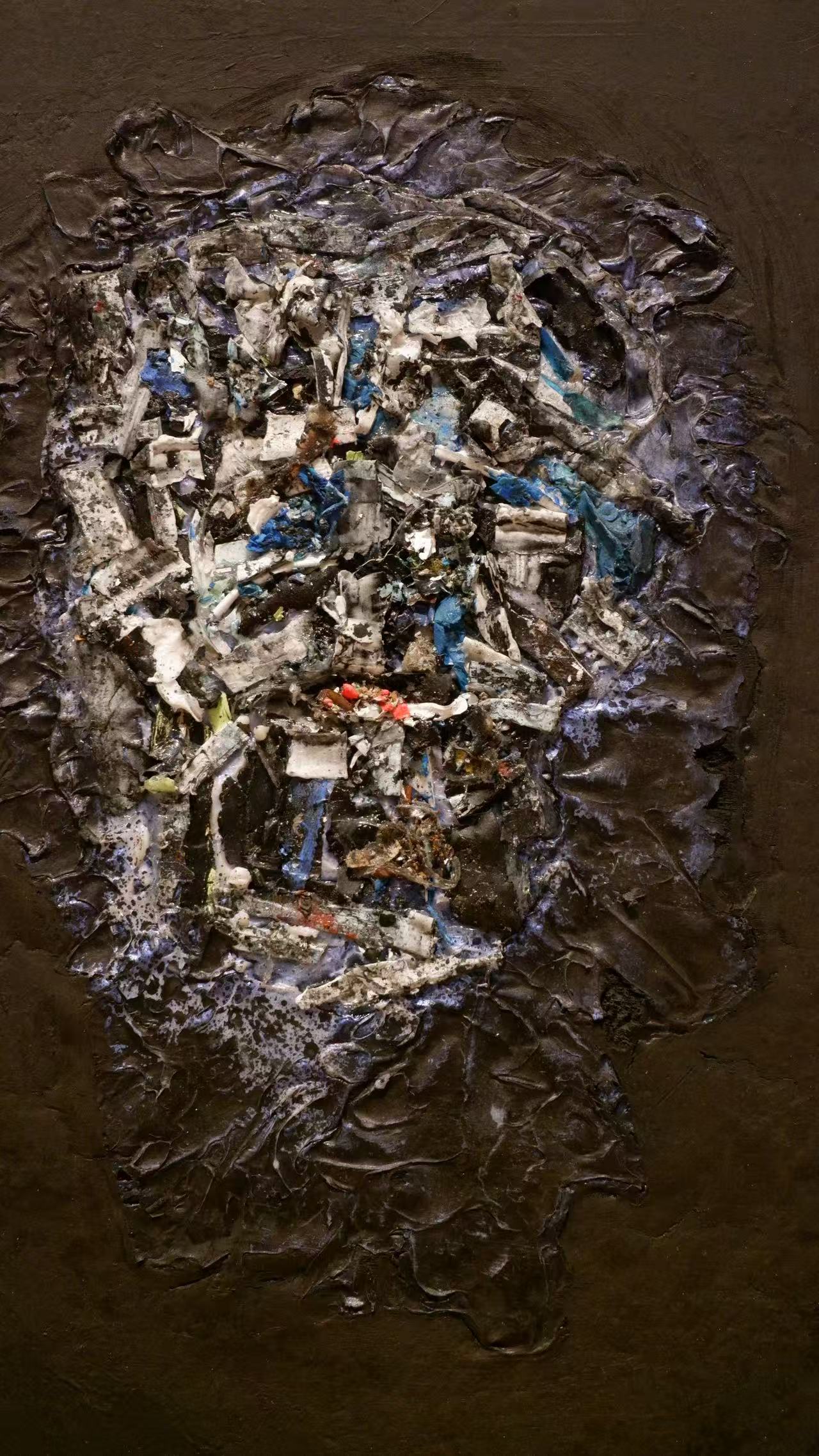
In a mechanical world, architecture is what brings our body into life, although, paradoxically, it is still shaped by machines. No matter how sheltered humans are from nature, or from bodily instincts, they cannot escape adapting their body to the architecture that accommodates them, in all spaces, at all time. Human sense are channeled through architecture through and through, and this is what MoMA showed me. The artwork below is Whitten’s self-portrait toward the end of his career. Its texture almost drove me crazy, with the uneven surface, and hoarded materials of scraps of life. Yet, perhaps this tingling sense of discomfort is the way that we as industrialized, institutionalized beings could finally connect ourselves back to our body.
